Your Cart is Empty




By Kailah, Founder of MG Naturals · Cosmetic formulator since 2014 · Last updated: May 2026
The short answer:it depends on which form, in which product, and on whose skin.
That's not the answer most beauty brands will give you, but it's the honest one. Titanium Dioxide is one of the most studied — and most controversial — cosmetic ingredients of the last decade. The science is genuinely complicated. The marketing is genuinely simplistic. And the gap between the two is where most consumers get confused.
I've spent the last twelve years formulating without it. Here's what I've learned, what the regulators have ruled, and what you should actually look for on your makeup labels.

Titanium Dioxide (chemical formula TiO₂, often listed as CI 77891 on labels) is a naturally occurring white mineral. In cosmetics, it's used for two main reasons:
As a white pigment to make foundations, BB creams, and lipsticks look opaque
As a brightening agent in powders and pressed products
It's used in roughly 90% of conventional foundations on the shelf today. If you've worn foundation in the last 30 years, you've almost certainly worn Titanium Dioxide.
In May 2021, the European Food Safety Authority (EFSA) published an updated safety assessment of Titanium Dioxide as a food additive (E171). After reviewing newer studies — particularly on nanoparticle absorption and genotoxicity (DNA damage) — they concluded that Titanium Dioxide "could no longer be considered safe when used as a food additive."
They couldn't establish a safe daily intake. They couldn't rule out concerns about cell damage. So the European Commission acted. By August 2022, Titanium Dioxide was banned as a food additive across the European Union.
The same ingredient is still permitted in lipstick, foundation, sunscreen, and other cosmetics.
This isn't an argument that all cosmetic Titanium Dioxide is dangerous. The science distinguishes between food (ingested) and cosmetics (applied topically), and the regulatory frameworks treat them differently. But it raises a fair question: if a regulator concluded the ingredient could damage cells when eaten, what's the long-term risk profile when it sits on your skin all day, every day, for forty years?
That question hasn't been clearly answered.
The photo-stability problem
There's a second concern with Titanium Dioxide that's specific to cosmetics it's not photo-stable.
In simple terms:when sunlight hits it on your skin, it generates free radicals. Free radicals are unstable molecules that damage skin cells and contribute to:
Premature ageing
Hyperpigmentation
Inflammation and skin barrier damage
Long-term cellular oxidative stress
Your antioxidant serums, your vitamin C, your retinol — they're all working to neutralise free radicals. If your foundation is creating them, half your routine is undoing the other half.
The cosmetics industry's solution to this is "coated" Titanium Dioxide, which uses a thin layer of silica or alumina (aluminium) to reduce photoreactivity. It helps. But coatings can degrade, not all brands use coated forms, and the underlying ingredient remains controversial — particularly when used in nano-particle form.
This is the question people search for most. The honest answer is: it's classified differently by different regulators, and the classification depends heavily on form and route of exposure.
In 2017, the European Chemicals Agency's Risk Assessment Committee proposed classifying Titanium Dioxide as a Category 2 suspected carcinogen — but specifically when inhaled as a powder.
This is an important distinction. Inhaled, fine-particle Titanium Dioxide has a different risk profile than the same ingredient bound into a foundation cream.
After twelve years of formulating without it and reading the research, here's where I land:
For occasional use in well-formulated, coated, non-nano forms — the immediate risk is moderate for most people.
For daily use over years and decades — the long-term data isn't there, and the existing data has enough question marks that I'm not willing to put it on my own kids.
For people with sensitive, reactive, or compromised skin — Titanium Dioxide is a common silent irritant.
For inhalation exposure (loose powders) — there's enough concern that careful application matters.
The cosmetics industry will tell you Titanium Dioxide is "safe." That's true in the regulatory sense — it's still legal. It's not the same as saying it's the best ingredient available, or that no concerns exist.
What to look for instead
If you want to reduce your Titanium Dioxide exposure, here's where to start:
Read the ingredient list. Look for "Titanium Dioxide," "CI 77891," or "TiO₂" — they're all the same thing.
Check the position. If it appears in the first 5 ingredients, it's a major component.
Watch for "[nano]" labelling. Nano forms raise additional concerns.
Look for alternatives: zinc oxide for protection, iron oxides for colour, plant-derived oils for hydration.
We removed Titanium Dioxide from every product in our range in 2014 — eight years before the EU made its food ruling. Not because we knew what was coming, but because once you read enough of the science, the question "do I want this on my skin every day?" becomes an obvious, no.
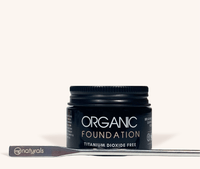
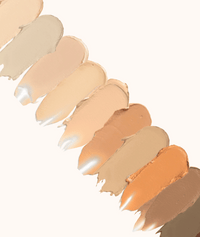
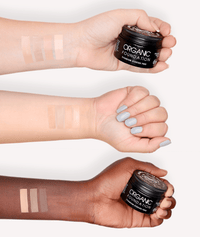
Our foundations use zinc oxide and iron oxides for coverage and colour. They're harder to formulate. They're more expensive to produce. They're slower to bring to market. But they're what we use on our own skin, and on our kids.
If you'd like to feel the difference yourself, our $2 BB Cream sample is the lowest-risk way to start.
_______________________________________________________________________________________________
Read more
How to read a foundation label