Your Cart is Empty




By Kailah Shannon — Founder of MG Naturals. Cosmetic Formulator since 2014.
Last updated: 5 May 2026

Trust me on top: Frontal fibrosing alopecia (FFA) is a scarring hair loss that pulls the hairline back at the forehead and temples and thins the eyebrows. It mostly shows up in women around and after menopause — and it was almost unheard of before 1994. Since then, cases have climbed sharply enough that researchers started looking for something in the environment that answers this sharp rise in numbers. One of the things they keep circling back to is titanium dioxide in leave-on face products (ie makeup).
This page answers one question plainly:why do most dermatologists now tell their FFA patients to cut titanium dioxide out of their skincare and makeup? Short version — particles of it have been found lodged in the hair follicles of FFA patients, and the leading theory is that they set off the immune reaction that scars the follicle shut. It isnot a settled, proven cause, but a growing body of evidence gives more than enough proof for dermatologists to urge sufferers to avoid Titanium Dioxide.

In 2018, a team of dermatologists at the Bichat and Rothschild Hospitals in Paris examined follicles plucked from an FFA patient who had used titanium-dioxide sunscreen daily for 15 years. Using a synchrotron — essentially an industrial-grade microscope at France's national physics facility — they mapped abnormal deposits clinging to the follicles and confirmed the metal inside them was titanium.
Their theory forwhy this matters points straight at the part of the follicle that hair grows from: titanium sitting in the follicle's stem-cell zone appears to trigger an immune "lichenoid" reaction — the same kind seen with metals like nickel — resulting in the destruction of hair follicle cells. Once that stem-cell region scars over, the follicle can't grow hair back. That's the difference between FFA and ordinary shedding/hair fall:it's permanent.
The Receipts Brunet-Possenti F, et al. Detection of titanium nanoparticles in the hair shafts of a patient with frontal fibrosing alopecia. Journal of the European Academy of Dermatology and Venereology, 2018; 32:e442–e443. (Imaging performed at Synchrotron SOLEIL, France.)
This is the detail that makes the theory click. The idea is that particles small enough to slip into the follicle opening provoke a localised immune response exactly where they land. As a 2022 paper in theAmerican Journal of Dermatopathology put it, these particles may be able to migrate into the follicular ostia and set off an immune reaction — which would explain why FFA strikes the frontal hairline and eyebrows while sparing the rest of the scalp, which is much further typically from topical Titanium Dioxide application.
The Receipts Are Sunscreen Particles Involved in Frontal Fibrosing Alopecia? American Journal of Dermatopathology, 2022.
In Melbourne, dermatologistProfessor Rodney Sinclair and Dr William Cranwell documented a 54-year-old woman whose FFA hadn't budged after a year of conventional treatments — triamcinolone, ciclosporin, dutasteride, minoxidil and spironolactone — and whose hairline kept receding. When the first studies implicating sunscreen appeared, they advised her to stop using it on her forehead. Their report notes that within six months, there wasnoticeable hair regrowth along the anterior hairline.
Read this one carefully, because it's easy to over-read. It's asingle patient, the improvement was credited toboth stopping the productand her ongoing medical treatment. It doesn't prove anything on its own. What it did was help push the question into mainstream dermatology. Sinclair has stayed on it since: he's a co-author on a 2025International Journal of Dermatology paper looking again at the titanium-dioxide link.
The Receipts Cranwell WC, Sinclair R. Frontal fibrosing alopecia: regrowth following cessation of sunscreen on the forehead. Australasian Journal of Dermatology, 2019; 60(1):60–61. · Yii, … Sinclair R, et al. Frontal Fibrosing Alopecia and Titanium Dioxide Nanoparticles. International Journal of Dermatology, 2025.

And in the peer-reviewed literature, a case-control study inActa Dermato-Venereologica landed on the same practical advice clinicians give patients — that people with FFA should avoid, or at least reduce... usage of cosmetic preparations containing titanium nanoparticles.
The Receipts Donovan J. Advice for "nano-free" titanium dioxide & zinc oxide products for patients with FFA (Donovan Hair Clinic patient advisory). · Lim HW, quoted in MDedge Dermatology, 2019. · Hair Shaft Morphology, Elemental Composition, and Nanoparticles in Frontal Fibrosing Alopecia: A Case-control Study. Acta Dermato-Venereologica, 2022.

We're not going to tell you this is a closed case, because it isn't.
Titanium dioxide has been found in the follicles of peoplewith and without FFA — so its mere presence doesn't prove it causes the disease.
The studies linking face products to FFA are mostly retrospective surveys, which carry recall bias.
At least one large study (451 women, Brazil) foundno link to sunscreen at all — though it did flag other leave-on facial products (cosmetics).
Across the research, the same words keep appearing:association, possible. That's exactly why the dermatologists who recommend avoiding titanium dioxide frame it as a sensible precaution while the science catches up.
If your dermatologist has advised you to reduce or remove titanium dioxide, the practical challenge is that it's nearly invisible on a label — it hides in sunscreens, foundations, BB creams, powders, and tinted moisturisers, often as the thing making a product opaque or "mattifying."
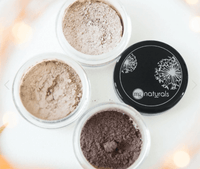
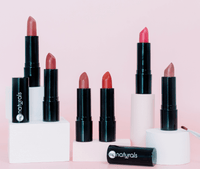
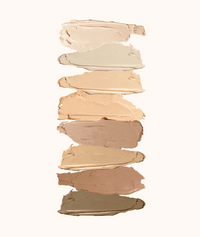
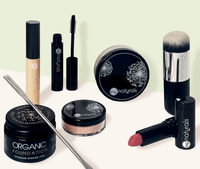
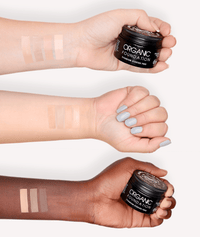
That's the entire reason MG Naturals exists: every product we make is formulatedwithout titanium dioxide, full stop. We can't and won't tell you it treats or prevents any condition — that's a conversation for you and your dermatologist. What we can tell you is that if you've been asked to take titanium dioxide off your shelf, you won't have to decode our labels to do it.
This page is educational. It reports what dermatologists and published research say about FFA and titanium dioxide. It isn't medical advice, and it isn't a claim about what any product does. If you have FFA or any hair-loss concern, follow the guidance of your own treating dermatologist.
Frequently Asked Questions
Read more
Why dermatologists tell people with FFA to avoid titanium dioxide? →