Your Cart is Empty




By Kailah, Founder of MG Naturals · Cosmetic formulator since 2014 · Last updated: May 2026
Most makeup buyers never flip the bottle over. The label on the back of your foundation is where the truth lives — and once you know how to read it, no marketing claim can mislead you again.
This guide takes 5 minutes to read. The skill it teaches you will save you thousands of dollars over your lifetime, and probably help your skin too.
By law, cosmetic ingredient lists must be ordered by concentration — the ingredient at the top is present in the highest amount, and the list descends from there. Once you hit ingredients listed at less than 1%, the order can be arbitrary.
This means the first 5–10 ingredients tell you what the product is mostly *made of*. The bottom of the list is usually preservatives, fragrance, and trace ingredients.
So when you check a label, focus on the top half. That's where you'll find both the good and the bad.
After eight years of formulating, these are the seven ingredients I won't put in our products and won't recommend in anyone else's:
1. Titanium Dioxide (CI 77891 / TiO₂)

The white pigment in roughly 90% of foundations. Not photo-stable in its standard form, generates free radicals in sunlight, and was banned by the EU as a food additive in 2022.
2. Anything labelled "[nano]"

Nanoparticles are small enough to be absorbed through the skin barrier. The EU requires "[nano]" labelling on cosmetics; brands that hide this are choosing convenience over caution.
3. "Fragrance" or "Parfum"

A legal loophole. The single word "fragrance" can hide up to 3,000 unlisted chemicals, none of which need to be disclosed. It's the number one trigger for sensitive skin reactions.
4. Bismuth Oxychloride

Common in mineral makeup for its pearly finish. Causes itching, burning, an
d the classic "cheek itch" in many sensitive skin types. Often misdiagnosed as something else.
5. Talc

Used as filler. The concern isn't talc itself — it's that talc deposits often contain asbestos contamination. Banned in baby powder by some manufacturers; still common in colour cosmetics.
6. Parabens

Methylparaben, propylparaben, butylparaben anything ending in -paraben. Suspected hormone disruptors. Cheap and effective preservatives, which is why they're still everywhere.
7. Synthetic dyes (FD&C, D&C colours)

Mostly coal-tar derived. Linked to skin irritation. Some are banned in the EU but still allowed in other markets. Look for iron oxides instead — natural mineral colour.
A foundation worth trusting will have most of these on the label:

1. Iron oxides (CI 77491, 77492, 77499) — natural mineral pigments,well-tolerated, photo-stable.

2. Zinc oxide — anti-inflammatory, gentle UV protection, soothesreactive skin.
3. Plant-derived oils — jojoba, carrot seed,

camellia, sunflower.Hydrating, nourishing.

4. A short ingredient list —10–20 items, mostly recognisable. The shorter, the more likely each ingredient is intentional.

5. A named formulator —if a brand will tell you who made the product, they're operating in the daylight.

5. Third-party heavy metal testing— rarely advertised, but reputable clean brands test their pigments through independent labs.
Next time you're standing in the makeup aisle:
Step 1: Flip the product over. Find the ingredient list.
Step 2: Scan the first 5 ingredients. Anything from the avoid list?
Step 3: Search (mentally or on phone) for: Titanium, Parfum, Fragrance, Paraben, Talc, Bismuth.
Step 4: Count how many of the 7 you found. 0–1 = relatively clean. 2–3 = typical mainstream. 4+ = your skin is doing more work than it should.
Step 5: Decide what your skin is worth.
"Clean," "natural," "green," and "non-toxic" are unregulated marketing terms. Anyone can use them. Specifically watch for:
"Made with natural ingredients" — could mean 1% natural and 99% synthetic. Ask which ingredients.
"Free from parabens and sulfates" — but still loaded with phthalates, fragrance, and Titanium Dioxide. Cherry-picking.
"Dermatologist tested" — meaningless without details. Tested by whom? For what? With what result?
"Hypoallergenic" — has no legal definition. The brand decided you wouldn't be allergic. They could be wrong.
Ingredient claims on the front, fine print on the back — always read the back, never trust the front.
Want a printable version?
We've put everything in this article — plus annotated photos of real labels — into a free 4-page PDF guide called The Ingredient Checklist. You can download it instantly here: [link to checklist]
The MG Naturals approach
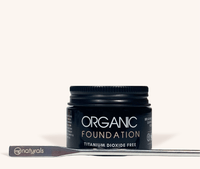
Every product in our range passes every check on this list. Titanium Dioxide free. Nanoparticle free. No fragrance loopholes. Iron oxides for colour. Zinc oxide for protection. Hand-formulated in Australia, third-party tested, with named formulators on every batch.
If you're switching to a brand that takes labels seriously, our $2 BB Cream sample is the easiest way to start.
Read more
Titanium Dioxide safe in makeup?