Your Cart is Empty




By Kailah, Founder of MG Naturals · Cosmetic formulator since 2014 · Last updated: September 2026
Titanium dioxide appears in foundations, concealers, powders, lip products and other colour cosmetics, often under the label name CI 77891. It is widely used as a white pigment that can increase opacity, brightness and coverage.[5]
The short answer: titanium dioxide is permitted in many cosmetic markets, but its regulatory status depends on the product, particle form, route of exposure and jurisdiction. The European Union’s decision to remove titanium dioxide as a food additive did not create a universal ban on titanium dioxide in makeup. Food, skin-contact and inhalation exposures must be assessed separately.[1][2][5]
Titanium dioxide is not essential to making foundation. Titanium-dioxide-free makeup can be formulated using carefully balanced pigments and base ingredients, although replacing its opacity and whitening effect requires deliberate formulation work.
This guide answers the practical questions customers ask most often without treating “permitted” as identical to “right for everyone”, or “titanium-dioxide-free” as an automatic guarantee that a product will suit every person.

Titanium dioxide is an inorganic compound with the chemical formula TiO₂. In colour cosmetics, it is commonly used as a white pigment and may appear on an ingredient list as Titanium Dioxide or CI 77891.[3][5]
Its physical properties allow it to scatter light effectively. In practical formulation terms, this can help make a product appear whiter, brighter or more opaque.[5]
Titanium dioxide may also be used as a UV filter in specifically formulated sunscreen products. However, its presence in an ordinary foundation does not, by itself, establish that the product provides reliable sun protection.[5]
A cosmetic should only be relied upon for sun protection when it carries a compliant SPF claim supported by the testing and regulatory requirements that apply in the market where it is sold.
For a more detailed introduction, visit the MG Naturals guide to what titanium dioxide is and where it is used.
Titanium dioxide is used in makeup primarily because it provides whiteness, opacity and coverage. It can help a foundation cover visible colour variation and can brighten the base of powders, concealers and other pigmented products.[5]
Its functions depend on how it has been processed and how it is used within the finished formulation. In colour cosmetics, manufacturers may use it to:
These technical advantages help explain why titanium dioxide is common, but common use does not mean that every brand must formulate with it. Different formulators can make different ingredient choices while still creating functional makeup.
The MG Naturals Titanium Dioxide Library includes a separate explanation of why titanium dioxide is widely used by the beauty industry.
On a cosmetic ingredient list, titanium dioxide is most commonly identified as Titanium Dioxide or CI 77891. In scientific or educational material, it may also be shortened to TiO₂.[3]
If you want to know whether a product contains it, check the complete ingredient list rather than relying only on the front label. Depending on the market and labelling format, colourants may appear near the end of the list or inside a “may contain” section covering several shades.
Useful terms to recognise include:
The phrase “mineral makeup” does not tell you whether titanium dioxide is present. The ingredient list is the more useful source of information.
For help interpreting the rest of a complexion formula, read How to Read a Foundation Label: A Complete Guide.
No. Not all mineral makeup contains titanium dioxide. It is common in mineral foundations and powders because of the coverage and opacity it can provide, but mineral makeup can be formulated without it.
“Mineral” should not be treated as a complete ingredient description. Two products marketed as mineral foundation may use different pigments, particle sizes, binders, surface treatments and supporting ingredients.
If avoiding titanium dioxide is important to you, check the ingredient list for the exact product and shade. A brand may use different pigment combinations across its colour range, and a statement about one product does not necessarily apply to every formula it sells.
Yes. Foundation can be formulated without titanium dioxide, but removing it changes the way a formulator builds opacity, shade balance and coverage.
Titanium dioxide is an efficient white pigment. Without it, a formulator cannot simply remove one ingredient and expect the formula to look and perform exactly the same. The complete pigment system and product base may need to be reconsidered.
Depending on the intended product, a titanium-dioxide-free formula may use a carefully balanced combination of:
These are examples of ingredients that may be used in titanium-dioxide-free formulation. They are not universal ingredients or direct one-for-one replacements for titanium dioxide. Each performs a different function, and the final result depends on the complete formula.
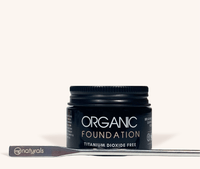
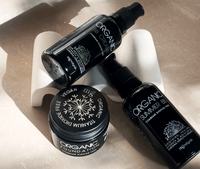
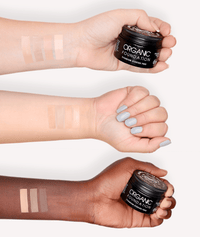
MG Naturals demonstrates that titanium dioxide is not technically essential to complexion makeup through its Organic BB Cream, Organic Liquid Foundation and Mineral Foundation Powder.
There is no universal substitute that recreates every function of titanium dioxide. Formulators usually need a combination of pigments and supporting materials chosen for the product’s intended shade, texture, finish and coverage.
Iron oxides can create red, yellow, brown and black tones used to build complexion shades. They are important in matching depth and undertone, but they do not reproduce the same bright white opacity as titanium dioxide on their own.
Zinc oxide may contribute whiteness and opacity and is also used as a UV filter in appropriately formulated products. Its presence alone does not turn ordinary makeup into a tested sunscreen, and no SPF claim should be inferred unless the finished product has completed the required testing.
Mica and other permitted mineral ingredients can influence slip, luminosity and light reflection. They may help create a smoother or more radiant finish, but they do not automatically provide the same coverage as titanium dioxide.
The oils, waxes, emulsifiers, powders and film-forming ingredients surrounding the pigments influence how evenly colour spreads and how much coverage the finished product appears to provide. Titanium-dioxide-free formulation is therefore a complete formulation decision, not simply an ingredient substitution.
Titanium dioxide was removed as an authorised food additive in the European Union, but that decision was not a universal ban on every use of titanium dioxide.
In 2021, the European Food Safety Authority reassessed titanium dioxide when used as the food additive E171. EFSA concluded that a concern for genotoxicity could not be ruled out and that titanium dioxide could no longer be considered safe when used as a food additive.[1]
The European Commission subsequently adopted Regulation (EU) 2022/63, which removed the authorisation for titanium dioxide as a food colour. Foods produced under the earlier rules could continue to enter the market during a transition period that ended on 7 August 2022.[2]
This decision concerned food-additive use and oral exposure. It did not automatically establish that every cosmetic use has the same exposure or risk profile.[1][5]
Swallowing a substance, applying it to the skin and inhaling airborne particles are different exposure routes. Evidence from one route should not be transferred directly to another without considering the product and exposure conditions.[5]
Yes. Titanium dioxide remains permitted for cosmetic use in a number of markets, subject to the rules that apply to the ingredient, particle form and product type.
In the United States, titanium dioxide is listed under 21 CFR §73.2575 as a colour additive permitted in cosmetics, including cosmetics intended for use around the eye, when used consistently with good manufacturing practice.[4]
Regulatory permission answers a specific question: whether an ingredient may be used under defined conditions. It does not mean that every formulation is identical, every exposure route is interchangeable or every customer must choose products containing the ingredient.
Regulations can change. Brands and consumers should check the current requirements in their own country rather than relying on a general statement about another jurisdiction.
Food and cosmetic exposure should not be treated as identical. Ingestion brings a substance into the digestive system, while a cream or pressed foundation is primarily applied to the skin. Loose airborne powder presents a separate inhalation consideration.[5]
An evidence-led assessment should consider:
This is why statements such as “it is banned” or “it is completely safe” can both be misleading when they omit the product type and route of exposure.
Yes. Particle size can affect how titanium dioxide behaves, which is why regulatory assessments distinguish between pigment-grade and nano forms and between dermal and inhalation exposure.[5]
“Nano” is not simply another word for “powder”. It refers to a particle-size category that may be subject to specific definitions and labelling requirements. The composition, coating, shape, aggregation and finished product format also matter.[5]
Consumers who want to understand this distinction can read the MG Naturals guide to nano versus non-nano titanium dioxide.
Yes. A loose powder can create airborne dust during dispensing and application, while a pigment bound into a liquid or cream behaves differently. That does not mean every loose powder produces the same level of exposure, but product format is relevant when considering inhalation.[5]
Practical ways to minimise airborne powder during makeup application include:
These are general dust-reduction practices. They should not be interpreted as a claim that a specific cosmetic product causes disease.
No. Titanium dioxide is not automatically irritating to everyone with sensitive skin, and sensitivity cannot be predicted from a single ingredient alone.
A reaction to makeup may involve fragrance, preservatives, colourants, botanical ingredients or another part of the formulation. It may also be irritant contact dermatitis rather than a true allergy.
If a product causes persistent burning, itching, swelling, hives or a rash, stop using it and seek advice from a qualified healthcare professional. Medical patch testing may be needed to identify a specific contact allergen.
Titanium-dioxide-free does not mean allergy-proof, non-irritating or suitable for every person. The complete ingredient list and finished formulation still matter.
Avoiding titanium dioxide is a personal formulation preference unless a qualified healthcare professional has advised you to avoid it for a specific reason. Current cosmetic regulations do not require every consumer to remove it from their makeup routine.
You may decide to seek titanium-dioxide-free products because:
Other consumers may be comfortable using permitted titanium dioxide in a well-formulated cosmetic. An evidence-conscious approach leaves room for informed choice rather than turning one formulation decision into a universal health claim.
MG Naturals has made titanium-dioxide-free formulation a defining part of its brand philosophy. This is a deliberate formulation choice rather than a claim that every cosmetic containing titanium dioxide is unsafe.
The brand creates colour and coverage through alternative pigment systems and publishes ingredient information so customers can make their own assessment. MG Naturals’ makeup principles also include nano-free, vegan and cruelty-free formulations.
Readers who want to understand the brand’s reasoning can explore why MG Naturals chooses to formulate without titanium dioxide and the wider MG Naturals Titanium Dioxide Library.
Customers who want to compare shades, textures and coverage before choosing a full-size complexion product can use the MG Naturals Discovery Samples Kit.

The most reliable first step is to read the complete ingredient list for the exact product and shade you intend to purchase.
A front-label claim such as “mineral”, “natural” or “clean” does not answer the question. Transparent, shade-specific ingredient information is more useful.
Titanium dioxide is used mainly as a white pigment and opacifier. It can increase coverage, lighten a shade and help reduce the transparency of the finished foundation.[5]
CI 77891 is the Colour Index designation commonly used for titanium dioxide on cosmetic ingredient lists.[3]
No. Titanium dioxide is common in mineral foundation, but mineral powder and liquid complexion products can be formulated without it. Always check the ingredient list for the exact product and shade.
Not automatically. A foundation should only be relied upon for sun protection when it carries a compliant SPF claim supported by testing of the finished product.
No. The European Union removed titanium dioxide’s authorisation as the food additive E171. That decision did not create a universal ban covering every cosmetic use.[1][2]
This article provides general cosmetic ingredient education. It does not provide medical advice or diagnose an allergy, sensitivity or health condition.
Is Titanium Dioxide Safe in Makeup? A Formulator’s Honest Answer