Your Cart is Empty



By Kailah, Founder of MG Naturals · Cosmetic formulator since 2014 · Last updated: May 2026
"Clean beauty" is one of the most powerful — and most misleading — terms in the cosmetics industry.
It promises something. It implies something. It charges a premium for something. And almost none of those things are legally defined, regulated, or consistent across brands.
This is an honest article from inside the industry. I run a clean beauty brand, and I'm going to tell you what the term actually means, what it doesn't mean, and how to tell the difference between brands that mean it and brands that are using the word.
The first thing to know: "clean beauty" has no legal definition
Anyone can call their product "clean." There is no certifying body, no regulatory standard, no required ingredient list, and no enforcement.
This isn't an oversight. The cosmetics industry has lobbied successfully for decades to keep its definitions vague and its regulations light. "Clean," "green," "natural," "non-toxic," and "hypoallergenic" are all marketing terms with no legal meaning.
This means the word "clean" on a bottle tells you what the brand wants you to feel. The ingredient list on the back tells you what's actually in it. Always trust the second one.
Despite the lack of a legal definition, the clean beauty movement has informally settled on a few common claims. Most brands using the term will avoid:
Parabens
Sulfates (SLS, SLES)
Phthalates
Formaldehyde
Some synthetic fragrances
PEGs
Triclosan
This is genuinely better than mainstream cosmetics. Removing these ingredients reduces certain risks. The clean beauty movement has done real good in pushing the industry forward.
But it's also incomplete.
Most clean beauty brands still use:
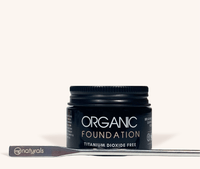
Titanium Dioxide.The white pigment in 90% of foundations. Photo-unstable, banned in EU food in 2022. Most clean brands still use it because removing it makes formulation significantly harder.
Nanoparticles.Small enough to absorb through skin. Many clean brands use them in sunscreens and foundations. EU requires labelling; many other markets don't.
"Natural fragrance" loopholes.Even "fragrance-free" or "naturally scented" products can contain undisclosed fragrance components. The legal loophole that allows "fragrance" to hide thousands of chemicals also applies to vague natural-sounding labels.
Untested heavy metal contamination.Iron oxides and other natural pigments can carry trace lead, arsenic, and mercury. Most clean brands don't third-party test for this — it's a separate certification entirely.
Mica.A common shimmer ingredient with significant child labour and ethical sourcing concerns. Most clean brands don't audit their mica supply chains.
Bismuth oxychloride.Used for the pearly finish in mineral makeup. Known irritant for sensitive skin. Common in clean mineral powders.
If you're switching to clean beauty because your skin reacts to mainstream products — and you're still reacting — this is probably why.
The label said "clean." The brand said "safe." But the same base ingredients are still in there. The marketing changed. The formulation, in many cases, didn't.
This isn't a take-down of clean beauty. The intent of most clean brands is genuinely good. But intent isn't an ingredient list, and "better than the worst options" isn't the same as "actually safe for sensitive skin."
Five questions to ask any brand calling itself clean:
1. Are you Titanium Dioxide-free?If yes, ask across the entire range — not just one product.
2. Are you nano-free?Specifically nano-free, and able to confirm in writing.
3. What's in your fragrance?If they say "natural fragrance," ask for the full list. If they decline, that's an answer.
4. Are you third-party tested for heavy metals?By which lab? Can you see results?
5. Who formulated this product?If they can't name the formulator, the product was made by an anonymous contract manufacturer to a generic brief.
Brands that answer these specifically and confidently are operating in good faith. Brands that hedge, deflect, or hide behind "proprietary blend" language are using clean beauty as marketing.
There's a slow, real shift happening in the cosmetics industry — not at the corporate level, but at the small, founder-led, often Australian level. A small number of brands are moving past "clean" into specific.
Specific is what "clean" should always have meant. It's where:
Every avoided ingredient is named, not just "toxins."
Every formulation choice is defensible with science, not slogans.
Every batch is traceable to the people who made it.
Every claim can be independently verified.
This is what the next decade of beauty will look like. The brands that survive will be the ones who stopped marketing and started disclosing.
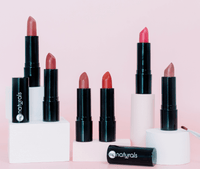
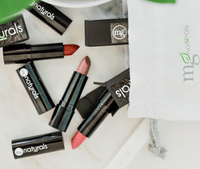
We removed Titanium Dioxide in 2018, before the EU acted on it. We removed mica from our lipsticks because we couldn't verify the supply chain. We third-party test every batch for heavy metals. Our formulator is named on every product. Our ingredient list is public. Our "no" list is published.
We don't always call ourselves clean — we call ourselves specific. That word matters.
If you've been reading this and thinking, "this is what I've been looking for," the easiest first step is a $2 BB Cream sample. No commitment, no compromise.
Read more
Titanium Dioxide safe in makeup?