Your Cart is Empty


QUICK ANSWER
Non-nano titanium dioxide (particles larger than 100nm) addresses one safety concern — the smallest particles being most reactive — but it doesn't address the others. Photocatalytic free-radical generation, daily cumulative exposure, inhalation from powders, and behaviour on compromised skin are properties of the titanium dioxide molecule itself, not just its nano form. "Non-nano" is a single data point that brands present as a complete answer.

If a brand has ever told you their titanium dioxide is "non-nano" and acted like that settles it — they're not telling you the whole story.
Nano refers to particles below a certain size threshold — generally 100 nanometres. Smaller particles are more concerning for inhalation and absorption. So "non-nano" — bigger particles — is presented as the safer option.
That's the pitch. Here's what it leaves out.
PEER-REVIEWED EVIDENCE
Photocatalytic free-radical generation is a property of the TiO₂ molecule itself, not just the nano-particle. Larger particles still generate reactive oxygen species under UV exposure — they just do it differently. "Non-nano" tells you a brand has avoided the smallest, most reactive particle size. It does not tell you the ingredient has stopped being photoreactive, or what happens when you apply it and walk outside into UV light.
Source:
Smijs & Pavel (2011). Titanium dioxide and zinc oxide nanoparticles in sunscreens: focus on their safety and effectiveness. Nanotechnology, Science and Applications, 4, 95–112.

"Non-nano" is one data point, marketed as the whole answer
Particle size matters. It is not the only thing that matters. Brands wave the "non-nano" flag and stop the conversation there because it's the easiest box to tick.


PEER-REVIEWED EVIDENCE
A study exposed human skin cells (HaCaT keratinocytes) to nano-TiO₂ under UVA light. The result: measurable reactive oxygen species generation, oxidative stress, and damage to skin cells. Manufacturers now coat TiO₂ particles with silica or alumina to suppress this — but later reviews concluded coatings reduce, not eliminate, photocatalytic activity. Nothing on a product label tells you whether the TiO₂ in your foundation is properly coated, partially coated, coated in aluminium or aged out of its coating.
Mineral powders are applied by tapping, swirling, buffing. That action puts particles into the air around your face. You breathe them.
The IARC classification of titanium dioxide as a Group 2B Carcinogen is specifically based on inhalation.
"Non-nano" might be enough for some women. It wasn't enough for us.
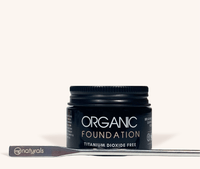
We didn't want to argue about how close to the line we could safely get. We wanted to step away from the line entirely. That's a different question. And a different brand.